Creative graphics won’t matter if your label wrinkles on a pouch or peels off in the fridge. That’s why it’s important to start with the container type and storage conditions, then work backward to plan your custom food label design.
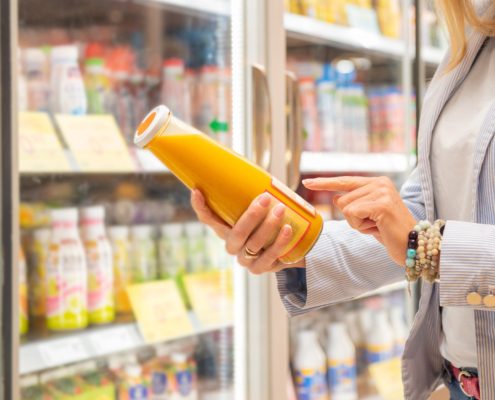
Condensation can be a major issue when labeling glass juice bottles stored in cold environments. In this case, a polypropylene film paired with a moisture-block adhesive helps prevent peeling and curling. The low surface energy makes it tough for standard adhesives to stick if your product uses HDPE plastic jugs, like many milk or dairy alternatives.
An aggressive acrylic adhesive with added lamination helps maintain a strong bond. For flexible packaging, such as smoothie pouches, constant bending and squeezing can quickly wear down the label. A thin BOPP (biaxially oriented polypropylene) material with a high-tack adhesive and a matte over-laminate offers flexibility and resilience.
When you choose the right adhesive and material specifications from the beginning, you unlock more room to layer in your brand personality, like using coatings and embellishments, bright colors, or textured accents, without risking poor performance once your product hits shelves or storage.